

Conventional and Unconventional Medicine:
Can They Be Integrated?


Archives of Internal Medicine 1998 (Nov 9); 158 (20): 2215-2224
James E. Dalen, MD, MPHTHIS ISSUE of the ARCHIVES, as well as the 8 other specialty journals and JAMA, is dedicated to complementary, alternative, and integrated medicine. Complementary and alternative medicine are also termed unconventional medical therapy, which Eisenberg et al1 have defined as "medical interventions that are not taught extensively at US medical schools or generally provided at US hospitals." Conventional medicine can then be defined as medical interventions that are taught extensively at US medical schools and generally provided at US hospitals.
Eisenberg and colleagues1 noted that 34% (60 million) of the general public in the United States reported using 1 or more forms of unconventional medicine in 1990. The most frequently used unconventional modalities are various forms of relaxation therapy,2, 3 chiropractic,4 acupuncture,5, 6 massage therapy,7 and herbal/mineral/vitamin supplements.8-10 The number of visits to unconventional providers in the United States in 1990 was greater than the number of visits to all primary care physicians. The total expenditures for unconventional therapy in 1990 amounted to $13.7 billion, $10.3 billion of which was paid out-of-pocket. In the vast majority of cases (89%), these visits to unconventional providers were not prescribed by a physician, and 72% of the patients did not discuss these visits with their physicians.1
What is the reason for this incredible disconnect? Patients seek unconventional medical care because they believe that it will, or does, help them. Why are conventional physicians reluctant to refer patients to unconventional therapy?
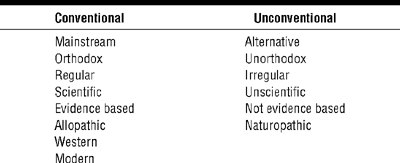
Some of the terms that are frequently used to differentiate conventional therapy from unconventional therapy are listed below:
Perhaps the most compelling (and most inflammatory) label is that conventional medicine is scientific and that unconventional is unscientific. It is a fact that many conventional physicians (ie, graduates of US medical schools) state that they do not refer patients to practitioners of unconventional medicine because their methods are not scientific and their qualifications are uncertain.
The definition of what is scientific in medicine obviously varies over time. I am sure that the leading conventional US physician of the 18th Century, Benjamin Rush, and his colleagues were convinced that bloodletting and purging were examples of scientific medicine. (I am not sure that George Washington agreed!)
At the present time in American medicine, scientific medicine is that which is judged to be evidence based. What is evidence-based medicine? In the 1990s, it means that a therapy has been shown to improve well-defined patient outcomes by well-designed, appropriately powered, randomized, controlled clinical trials. All drugs that have been approved by the Food and Drug Administration since the 1960s have met this standard. Conversely, many therapies introduced before the 1960s do not meet our current definition of scientific, or evidence-based, medicine.
Let us look at our current therapies for cardiovascular diseases. Cardiovascular diseases and their outcomesmyocardial infarction, stroke, pulmonary embolism, and death
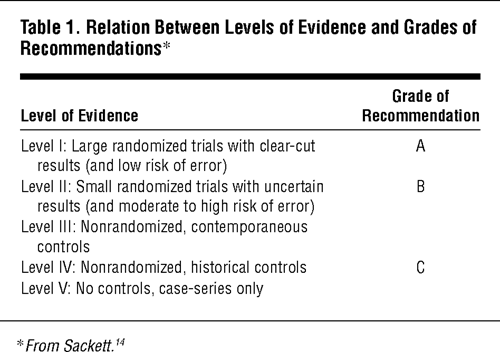
What is the scientific evidence that these 3 drugs prevent myocardial infarction, stroke, pulmonary embolism, or death? The American College of Chest Physicians (ACCP) Consensus Conference on Antithrombotic Therapy was convened in 1985 to examine the available evidence and to make recommendations for antithrombotic therapy. Their recommendations were graded A, B, or C according to the rules of evidence described by Sackett14 (Table 1). Grade A recommendations, based on the results of appropriately designed randomized clinical trials, were considered to be evidence based.
After the available evidence on the efficacy and safety of these agents was examined, it was found that only 24% of the 1986 recommendations were based on grade A evidence; ie, only 24% of their recommendations were evidence based as currently defined.15 Of note, 55% of their recommendations were based on uncontrolled clinical observations and therefore were grade C (most evidence for the efficacy of unconventional therapies is grade C at best.) The ACCP consensus conferences helped to stimulate a flurry of appropriately designed randomized clinical trials on antithrombotic therapy from 1986 to 1998. The fifth ACCP Consensus Conference on Antithrombotic Therapy, which took place in 1998,16 reflects the impact of these trials: 44% of the 1998 recommendations are grade A, ie, evidenced based. Nearly all the recommendations for therapies recently approved by the Food and Drug Administration (thrombolytics, ticoplidine, platelet glycoprotein II/IIIA antagonists) are grade A. However, many of the recommendations for the older, widely prescribed drugs (warfarin, heparin, and aspirin) remain grade C (not evidence based). If these therapies (eg, warfarin to prevent stroke in patients with mitral stenosis complicated by atrial fibrillation) are not evidence based as currently defined, are they unconventional therapies?
The reason that most unconventional therapies are not evidence based as currently defined is that most of them were introduced long before (in some cases centuries before) the advent of the randomized controlled clinical trial. It is also true that most therapies considered to be unconventional arose outside modern mainstream Western medicine.
Further examples of non–evidence-based therapies that are or have been widely prescribed by Western physicians for patients with cardiovascular disease are evident in the use of various procedures (which are less tightly regulated than drugs.) Coronary artery bypass grafts were first performed in 1964.17 The efficacy of this procedure based on the early reports seemed self-evident. Therefore, the procedure was performed in hundreds of thousands of patients with coronary artery disease, even though its efficacy was not confirmed by randomized clinical trials until 1977.18 Percutaneous transluminal coronary angioplasty followed a similar course. It was described in 1979,19 and, as in the case of coronary artery bypass grafts, was then performed in hundreds of thousands of patients prior to the first randomized clinical trial demonstrating efficacy in 1992.20 The procedure of bedside pulmonary artery catheterization was described in 1970,21 and it has been performed in millions of patients without scientific evidence that it improves patient outcomes.22 In fact, some studies have suggested that it may in fact cause harm to some patients.23
It is clear that many of the therapies prescribed by Western-trained physicians are not evidence based as currently defined. Does this mean that they should be defined as unconventional therapies? I believe that the reason that they are not considered to be unconventional therapies is that they were introduced from the mainstream of Western medicine. Does this mean that they should be abandoned? I think not. It means that they should be subjected to appropriately designed randomized clinical trials to establish their efficacy and safety.
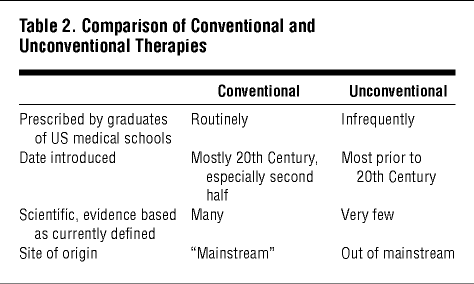
Table 2 compares various characteristics of conventional medical therapies with those of unconventional therapies. The fact that unconventional therapies are infrequently prescribed by graduates of US medical schools is not surprising, since unconventional therapy is infrequently taught in US medical schools. As noted above, many, but not all, conventional therapies are evidence based, whereas very few unconventional therapies are evidence based. One of the reasons that most unconventional modalities are not evidence based is that the majority of them were introduced prior to the 20th Century; therefore, they were not subjected to randomized clinical trials.
In my opinion, the principal distinguishing characteristic of unconventional and conventional medicine therapies is their source of introduction. Conventional therapies are introduced by mainstream Western physicians and scientists, whereas most unconventional modalities are introduced by "outsiders." I agree with Goodwin and Tangum,24 who, in this issue of the ARCHIVES, conclude that American academic medicine has a bias against outsiders who make therapeutic suggestions, especially when they take their message directly to the public.
Promising unconventional therapies must be subjected to the same level of scientific scrutiny that we now require for drug therapies introduced by "mainstream" medicine. As physicians whose job description requires us to help people, we cannot reject "out-of-hand" any proposed therapies just because they did not originate in modern mainstream medicine. We cannot wear blinders!
This is the challenge for integrative medicine! The leaders of integrative medicine must sort through the myriad of proposed unconventional therapies to determine which should be subjected to appropriately designed clinical trials. The best candidates for study may be those that meet at least grade C levels of evidence, as outlined by Sackett in Table 1.
If a therapy that arose from outside the mainstream of modern Western medicine can pass the same level of scrutiny that we expect of conventional therapies, it should be integrated into mainstream medicine and added to the therapeutic armamentarium of the well-trained, conventional physician. We can do no less for our patients!
We could learn from the Navajo, as described by Kim and Kwok25 in this issue of the ARCHIVES. The Navajo have integrated unconventional Western medicine, which is provided by the Indian Health Service, into their centuries-old conventional health care, which is provided by native healers.
Author/Article Information
James E. Dalen, MD, MPH
Editor
REFERENCES:
1. Eisenberg DM, Kessler RC, Foster C, Morlock FE, Calkins DR, Delbanco TL.
Unconventional Medicine in the United States: Prevalence, Costs, and Patterns of Use
New England Journal of Medicine 1993 (Jan 28); 328 (4): 246–252
MEDLINE
2. Kabat-Zinn J, Lipworth L, Burney R.
The clinical use of mindfulness meditation for the self-regulation of chronic pain.
J Behav Med.
1985;8:163-190.
MEDLINE
3. Bernhard J, Kristeller J, Kabat-Zinn J.
Effectiveness of relaxation and visualization techniques as an adjunct to phototherapy and photochemotherapy of psoriasis.
J Am Acad Dermatol.
1988;19:572-573.
MEDLINE
4. Kaptchuk TJ, Eisenberg DM.
Chiropractic Origins, Controversies, and Contributions
Archives of Internal Medicine 1998 (Nov 9); 158 (20): 2215-2224
5. White AR, Resch K-L, Ernst E.
Randomized trial of acupuncture for nicotine withdrawal symptoms.
Arch Intern Med.
1998;158:2251-2255.
MEDLINE
6. Ernst E, White AR.
Acupuncture for back pain: a meta-analysis of randomized controlled trials.
Arch Intern Med.
1998;158:2235-2241.
MEDLINE
7. Field T, Henteleff T, Hernandez-Reif M, et al.
Children with asthma have improved pulmonary functions after massage therapy.
J Pediatr.
1998;132:854-858.
MEDLINE
8. Winslow LC, Kroll DJ.
Herbs as medicines.
Arch Intern Med.
1998;158:2192-2199.
MEDLINE
9. Miller LG.
Herbal medicinals: selected clinical considerations focusing on known or potential drug-herb interactions.
Arch Intern Med.
1998;158:2200-2211.
MEDLINE
10. Mashour NH, Lin GI, Frishman WH.
Herbal medicine for the treatment of cardiovascular disease: clinical considerations.
Arch Intern Med.
1998;158:2225-2234.
MEDLINE
11. Murray G.
Anticoagulants in venous thrombosis and the prevention of pulmonary embolism.
Surg Gynecol Obstet.
1947;84:665-668.
12. Craven LL.
Acetylsalicylic acid, possible preventive of coronary thrombosis.
Ann West Med Surg.
1950;4:95-99.
13. Barritt DW, Jordan SC.
Anticoagulant drugs in the treatment of pulmonary embolism: a controlled trial.
Lancet.
1960;1:1309-1312.
14. Sackett DL.
Rules of evidence and clinical recommendations on the use of antithrombotic agents.
Chest.
1986;89(suppl):2S-3S.
MEDLINE
15. First ACCP Conference on Antithrombotic Therapy.
Chest.
1986;89(suppl):1S-106S.
MEDLINE
16. Fifth ACCP Conference on Antithrombotic Therapy.
Chest.
In press.
17. Garrett HG, Dennis EW, DeBakey ME.
Aortocoronary bypass with saphenous vein graft.
JAMA.
1973;223:792-794.
MEDLINE
18. Murphy ML, Hultgren HN, Detre K, Thomsen J, Takaro T.
Treatment of chronic stable angina: a preliminary report of survival data of the randomized Veterans Administration Cooperative Study.
N Engl J Med.
1977;297:621-627.
MEDLINE
19. Grüntzig AR, Senning Å, Siegenthaler WE.
Nonoperative dilation of coronary-artery stenosis: percutaneous transluminal coronary angioplasty.
N Engl J Med.
1979;301:61-68.
MEDLINE
20. Parisi AF, Folland ED, Hartigan P.
A comparison of angioplasty with medical therapy in the treatment of single-vessel coronary artery disease.
N Engl J Med.
1992;326:10-16.
MEDLINE
21. Swan HJC, Ganz W, Forrester J, Marcus H, Diamond G, Chonette D.
Catheterization of the heart in man with use of a flow-directed balloon-tipped catheter.
N Engl J Med.
1970;283:447-451.
MEDLINE
22. Dalen JE, Bone RC.
Is it time to pull the pulmonary artery catheter?
JAMA.
1996;276:916-918.
MEDLINE
23. Connors AF, Speroff T, Dawson NV, et al.
The effectiveness of right heart catheterization in the initial care of critically ill patients.
JAMA.
1996;276:889-897.
MEDLINE
24. Goodwin JS, Tangum MR.
Battling quackery: attitudes about micronutrient supplements in American academic medicine.
Arch Intern Med.
1998;158:2187-2191.
MEDLINE
25. Kim C, Kwok YS.
Navajo use of native healers.
Arch Intern Med.
1998;158:2245-2249.
MEDLINE

Return to ALT-MED/CAM ABSTRACTS
| Home Page | Visit Our Sponsors | Become a Sponsor |
Please read our DISCLAIMER |