

Backpacks and Children This section was compiled by Frank M. Painter, D.C.
Send all comments or additions to: Frankp@chiro.org


|
|
Conditions That Respond | Alternative Medicine Approaches to Disease |
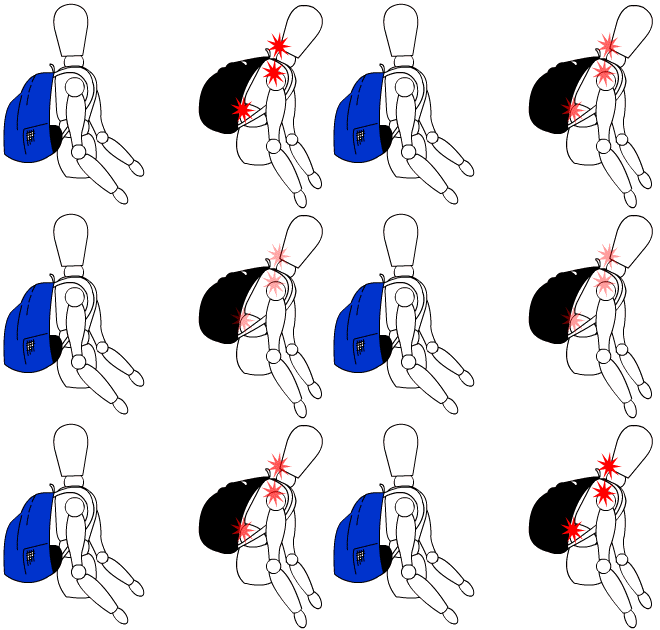
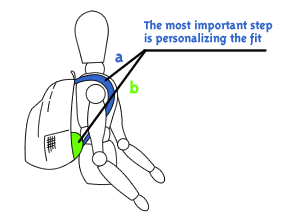
An example of proper and improper spinal loading

Schoolbags and Back Pain in Children Between
8 and 13 Years: A National Study
Br J Pain. 2017 (May); 11 (2): 81–86 ~ FULL TEXT
Over 70% of the subjects had a schoolbag that exceeded the recommended 10% bag weight to body ratio. A total of 32% of the sample complained of back pain, with 74% of these defining it as low in intensity on the face pain scale-revised. The presence of back pain was statistically related to gender, body mass index (BMI), school and bag weight to body weight ratio. After adjusting for other factors, self-reported back pain in schoolchildren is independently linked to carrying heavy schoolbags. This link should be addressed to decrease the occurrence of back pain in this age group.
Quality of Life, School Backpack Weight, and Nonspecific
Low Back Pain in Children and Adolescents
J Pediatr (Rio J). 2015 (May); 91 (3): 263–269 ~ FULL TEXT
Girls reported higher disability than boys (p = 0.01), and lower QoL in the domains of physical (p < 0.001) and emotional functioning (p < 0.01), psychosocial health (p = 0.02) and physical health summary score (p < 0.001), and on the total PedsQL score (p < 0.01). School backpack weight was similar in both genders (p = 0.61) and in participants with and without LBP (p = 0.15). After adjustments, participants with LBP reported lower physical functioning (p < 0.01), influencing lower physical health summary score (p < 0.01).
School Children's Backpacks, Back Pain and Back Pathologies
Arch Dis Child. 2012 (Aug); 97 (8): 730–732
Carrying backpacks increases the risk of back pain and possibly the risk of back pathology. The prevalence of school children carrying heavy backpacks is extremely high. Preventive and educational activities should be implemented in this age group.
Effect of Backpack Load Carriage on Cervical Posture
in Primary Schoolchildren
Work. 2012 (Jan 1); 41 (1): 99–108
Subjects demonstrated immediate and statistically significant changes in craniovertebral angle (CVA), indicating increased forward head positions upon donning the backpacks containing 15% and 20% body weight. Following the walking of 6 minutes, the CVA demonstrated further statistically significant changes for all backpack loads indicating increased forward head postures. For the 15 & 20% of body weight conditions, more than 50% of the subjects reported discomfort after walking, with the neck as the primary location of reported pain.
Comparison of the Posture of School Children
Carrying Backpacks Versus Pulling Them on Trolleys
Clinical Chiropractic 2010 (Dec); 13 (4): 253–260
This small trial explored whether using an airport-luggage style trolly might reduce spinal stress in school children. What might work at the airport for Mom does not seem to work so well for Junior, lugging their schoolbooks along uneven sidewalks on the way to school. The authors had to conclude: “This suggests that school children should use backpacks rather than trolleys when the weight is within recommended limits”.
Postural Sway Modifications Induced by Backpack
Carriage in Primary School Children:
A Case Study in Italy
Ergonomics. 2010 (Jul); 53 (7): 872–881
Loss of balance is among the primary causes of unintentional falls and postural sway represents an effective indicator of balance abilities. In this study, sway parameters were assessed in primary school children wearing backpacks. The differences that were observed show that backpack carriage potentially increases the risk of falls.
The Effect of Backpacks on the Lumbar Spine in Children:
A Standing Magnetic Resonance Imaging Study
SPINE (Phila Pa 1976) 2010 (Jan 1); 35 (1): 83–88 ~ FULL TEXT
This is the first study to use advanced imaging to demonstrate how backpack loads are responsible for a significant amount of back pain in children, which in part, may be due to changes in lumbar disc height or curvature. This is the first upright MRI study to document reduced disc height and greater lumbar asymmetry for common backpack loads in children.
Effect of Backpack Weight on Postural Angles
in Preadolescent Children
Indian Pediatr. 2010 (Jul 7); 47 (7): 575–580
Carrying a backpack weighing 15% of body weight changes all the postural angles in preadolescent children.
Association of Relative Backpack Weight With Reported Pain,
Pain Sites, Medical Utilization, and Lost School Time
in Children and Adolescents
J Sch Health. 2007 (May); 77 (5): 232–239
Five hundred and thirty-one 5th– to 12th–grade Northern California students and their backpacks were weighed. Students were individually interviewed about how often they experienced pain while carrying a backpack, the site of their pain, and if the pain had interfered with school activities or led to medical care. Greater relative backpack weight is associated with upper- and mid-back pain reports but not neck or lower back pain; it is also associated with lost school time, lost school sports time, and greater chiropractic utilization.
Schoolbag Weight and Musculoskeletal Symptoms
in New Zealand Secondary Schools
Applied Ergonomics 2005 (Mar); 36 (2): 193–198
Musculoskeletal symptoms were reported by 77.1% of the students. Symptoms were most prevalent in the neck, shoulders, upper back and lower back. Although musculoskeletal symptoms are believed to be multifactorial in origin, the carriage of heavy schoolbags is a suspected contributory factor and may represent an overlooked daily physical stress for New Zealand secondary school students.
Influence of School Backpacks on Adolescent Back Pain
J Pediatr Orthop 2004 (Mar); 24 (2): 211–217 ~ FULL TEXT
In a sample of 3,498 students living in two counties in California, each student's weight and backpack load were measured. Demographic information as well as information about backpack use was obtained. Nonspecific mechanical back pain was found to be highly prevalent, and the reported severity and chronicity of pain were high. Controlling for age, socioeconomic status, walking to and from school, and method of wear, results indicated that backpack weight, measured as a percentage of body weight, was effective in predicting back pain (P < 0.01).
The Association of Backpack Use and Back Pain in Adolescents
Spine (Phila Pa 1976) 2003 (May 1); 28 (9): 922–930
Of 1122 backpack users, 74.4% were classified as having back pain, validated by significantly poorer general health, more limited physical functioning, and more bodily pain. As compared with no or low use of backpacks at school, heavy use (odds ratio, 1.98; P < 0.0001) wasindependently associated with back pain. Female gender and larger body mass index also were significantly associated with back pain.
Mounting Research on Backpack Use
ICPA Newsletter (May/June 2002) ~ FULL TEXT
For many students, "hitting the books" leads to academic achievement. Students who carry those books in overloaded backpacks may be unknowingly participating in the beginning of a health epidemic. Scientific research reveals an alarming danger associated with improper childhood backpack use. This research stems from the increasing number of reports of childhood back pain in recent decades.
COCSA will initiate a “National Backpack Safety Month” in April 2002
Dynamic Chiropractic (February 25, 2002)
The Congress of Chiropractic State Associations (COCSA) will initiate a "National Backpack Safety Month" in April to promote backpack safety. This program aims to educate students, parents and teachers about injuries caused by the ubiquitous, heavy backpacks kids tote to school every day, and how to prevent those injuries.
Effects of Backpacks on Students:
Measurement of Cervical and Shoulder Posture
Aust J Physiother 2001; 47 (2): 110–116
The aims of this pilot study were to determine whether the weight of a backpack, its position on the spine or time carried affected adolescents cervical and shoulder posture. Standing posture measured from the sagittal and frontal planes of 13 students was recorded photographically under several load carrying conditions. Cervical and shoulder position angles were calculated and compared. Results revealed that both backpack weight and time carried influenced cervical and shoulder posture. Forward Head Posture increased when carrying a backpack, especially one with a heavy load. Carrying a backpack weighing 13% of body weight appeared to be too heavy to maintain standing posture for adolescents. These findings have implications for future load carrying studies in adolescents.
Improper Use of Backpacks Leads to Chronic Back Pain
American Chiropractic Association
Back pain is pervasive in our society. Eighty percent of all Americans will suffer from it at some point in their lives, and 50 percent of us will suffer from low-back pain this year alone. Low-back pain is the most common health problem experienced by working Americans today, and a condition which costs our nation’s economy at least $50 billion a year in lost wages and productivity. Much of this suffering is brought on by bad habits initiated during our younger years – such as carrying overweight backpacks to school. The improper use of backpacks can lead to muscle imbalance that could turn into chronic back and neck problems later in life.
Book Bags ~ What Every Parent Should Know
ICPA Newsletter November/December 2000 ~ FULL TEXT
Chiropractors have long recognized the spinal health hazards of heavy backpack use. Now, research presented at the American Academy of Physical Medicine and Rehabilitation's annual meeting exposes yet another potential danger of heavy backpacks: They promote falls in students who wear them.
Kids Risk Aches, Pains or Worse with Overloaded Packs
The Arizona Republic (Aug 14, 2000)
Students carrying more than 10 percent of their body weight are susceptible to lower-back and spinal pain, with female students more susceptible than males and younger students more prone to injury, according to a study by the University of South Australia.
Survey Finds Back Packs Can Cause Students Problems
Orthopedics Update (7–17–2000)
NEW YORK – Back to school should not signal the start of aches and pains, but for many youth who use back packs, it could be full of visits to the physician's office.
Posturing for Wellness:
Good Health Begins with Good Posture
ACA News (May 2000) Doctors of chiropractic have long emphasized the importance of posture and other lifestyle factors in the body's ability to function optimally. In a broad sense, good posture can be considered an ongoing battle against bad habits.
A Pain in the Backpack
CNN and WebMD (February 24, 2000)
Alexa Sloan, a slim 16–year-old, carries her world in a backpack. Slung fashionably over her shoulder, it contains several textbooks, her notebooks, day planner, lunch, posters and school projects such as the 3–D model of a cell membrane that she created for biology class. Sloan, a sophomore at Walt Whitman High School in Bethesda, Maryland, typically carries 25 to 30 pounds in her black one-strap backpack. Too heavy, she knows, but she's reluctant to forego the convenience offered by her backpack. "I have shoulder pains. There's a sore, pulling feeling and I worry about my spine being bent over all crooked under the weight," she says. "But I dont really have a choice. Theres not enough time between classes to go to my locker."
Carrying the Back Pack Issue into the School
ICPA Newsletter November/December 1999 ~ FULL TEXT
As academic requirements are raised up, so are the amounts of books students are carrying to and from school. Parents, school officials and health care providers have growing concerns with the increased amount of weight being carried each day. According to a recent news article, the issue has taken on serious implications and pediatricians have said that school children should not carry more than 10 % of their own body weight. Dr. Wayne Yankus, of the American Academy of Pediatrics says, "There is a growing concern that youngsters may have long term back problems from trudging about with such heavy loads."
AAOS Tells Media Backpacks Can Cause Problems
American Academy of Orthopedic Surgeons 1999 (Dec): 47 (6)
An Academy survey of 101 physicians disclosed that 58 percent had seen school-age patients complaining of back and shoulder pain caused by heavy backpacks. "If you have an 90–pound female carrying a 20–pound backpack, then the backpack weight becomes a medical issue," Dr. Alexander said. "Most of the students surveyed are carrying backpacks weighing more than 10 percent of their body weight," Dr. Alexander said. "We found one 10–year old female student with a backpack weighing 47 pounds."
Backpack as a Daily Load for Schoolchildren
Lancet 1999 (Dec 4); 354 (9194): 1974
34.8% of Italian schoolchildren carry more than 30% of their bodyweight at least once a week, exceeding limits proposed for adults. Given increasing evidence of back pain in children, the time has come to propose some limitations to backpack load.
The Associations Between Adolescent Head-on-neck Posture,
Backpack Weight, and Anthropometric Features
SPINE (Phila Pa 1976) 1999 (Nov 1); 24 (21): 2262–2267
A significant change in craniovertebral angle was found at every year level, when comparing standing posture with no backpack with posture when carrying a backpack. The change was greatest for the youngest students.
Changes of Contour of the Spine Caused by Load Carrying
Surg Radiol Anat 1999; 21 (2): 109–113
Using a Vicon 140 3-D system we measured the effective mobility of the different spinal segments in the sagittal plane during one step. For every subject, we noticed a significant decrease of the effective inter-segmental mobility (EISM) between S1–L3–T12 (p < .01) while backpacking a 22.5 kg load.
Backpacks ~ Your Child's Spine is at Stake
ICPA Newsletter November/December 1998 ~ FULL TEXT
The ICPA draws our attention to the risks associated with backpacks. This article, written before it's publication in late 1998, is most likely the first chiropractic article on the subject. Good going, Rich!
Backpack Misuse Leads to Chronic Back Pain
Back pain is pervasive among American adults, but a new and disturbing trend is emerging. Young children are suffering from back pain much earlier than previous generations, and the use of overweight backpacks is a contributing factor, according to the American Chiropractic Association (ACA). In fact, the U.S. Consumer Product Safety Commission reports that backpack-related injuries sent more than 7,000 people to the emergency room in 2001 alone.
Influence of Carrying Book Bags on Gait Cycle
and Posture of Youths
Ergonomics 1997 (Jun); 40 (6): 631–641
Subjects were filmed, with and without backpacks and gym bags, and observed for lateral spinal deviation, shoulder elevation, stride length/frequency and anteriority of head and trunk, and found that carrying book bags on one shoulder significantly alters the posture and gait of youthful students.
Weighing in on Backpack Safety:
Tips for Toting School Gear Without Physical Injuries
Mark D. Widome, MD
Is the back a good place to carry books? Yes. The vast majority of students in elementary school, high school, and on college campuses opt for backpacks, as opposed to hand-held book bags. It is not only a fashion statement, but a logical choice for a way to carry a heavy load.
Return to the LINKS Home Page
Return to the PEDIATRICS Section
Since 10–07–2000
Updated 7-22-2022

| Home Page | Visit Our Sponsors | Become a Sponsor |
Please read our DISCLAIMER |