

Jump to: Introduction The Medical Solution
Repetitive Stress Disorders This section was compiled by Frank M. Painter, D.C.
Send all comments or additions to: Frankp@chiro.org
Patient's Guide to Cumulative Trauma Disorders
Articles About Repetitive Stress Other Resources


Introduction
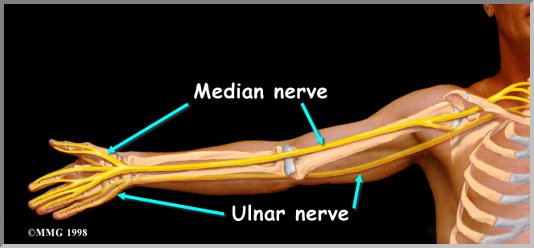
There is a huge difference between chiropractic management and medical management of disorders like Carpal Tunnel. There are pictures below of typical medical management. A chiropractor knows that if your hands have pain and tingling, that the first place to look is your neck, specifically in the mid to lower cervical spine. That is where the nerve roots which make up the brachial plexus originate. Then the brachial plexus divides into named nerves like the median and ulnar nerve. You will see the brachial plexus forming from the nerve roots on the right side of this picture.
Thanks to: A Patient's Guide to Carpal Tunnel Syndrome for the use of this picture!
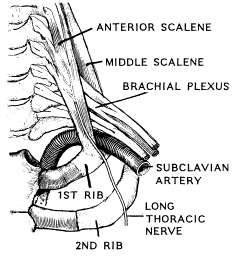
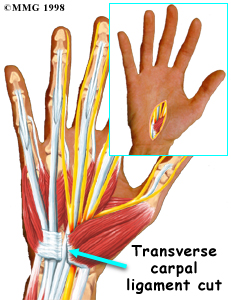
Between the neck and the wrist, there are many possible locations for the “double crush” phenomenon. What does that mean? If there is irritation of a nerve root at the intervertebral foramina, or if there compression at the triangle formed between the scalene muscles and the first rib (see the sketch on the left), the nerve itself becomes stressed. Then, as that nerve passes into the arm, it passes through several muscles before it enters the hand, beneath the transverse carpal ligament. If that nerve is already sick, the “secondary stress” of compression within the arm muscles, or at the wrist, may cause regional (down stream) symptoms. We call that second insult to the nerve a “double crush” phenomonon.
When a chiropractor adjusts the neck and removes the irritation at the nerve roots, the secondary, or downstream symptoms simply resolve. This is true for entrapment syndromes (which may have developed associated muscle adhesions or “trigger points”) and for the well publicized “carpal tunnel syndrome”.
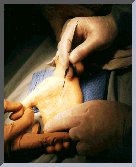
The Medical Solution Is Often Surgery
Thanks to: A Patient's Guide to Carpal Tunnel Syndrome for the use of these pictures!
Articles About Repetitive Stress

The Carpal Tunnel Syndrome Page
A Chiro.Org article collection
Review the research supporting Chiropractic Care for Carpal Tunnel Syndrome, as well as other conservative menagement options from the Chiropractic Research Results for a Variety of Conditions Page.

Neurodynamic Mobilization in the Conservative
Treatment of Cubital Tunnel Syndrome:
Long-Term Follow-Up of 7 Cases
J Manipulative Physiol Ther. 2010 (Feb); 33 (2): 156–163 ~ FULL TEXT
This case series demonstrated that conservative treatment of CTS may be beneficial for selected patients with mild to moderate symptoms. The treatment included neurodynamic mobilizations, including sliding techniques and tensioning techniques, which are thought to enhance ulnar nerve gliding and restore neural tissue mobility. Conservative treatment using neurodynamic mobilization with patient education and activity modification demonstrated some long-term positive results.
Occupational Injuries Suffered by Classical Musicians
Through Overuse
Clinical Chiropractic 2004 (Jun); 7 (2): 55–66
There is a high rate of injury to professional classical musicians and teachers that can be disruptive to practice and potentially threatening top careers. Females and string players were discovered to be of particular risk. The majority of injuries were to the shoulder and proximal thoracic spine and the absence of injuries in amateur players suggests a relationship to overuse. The author suggests that the incorporation of postural and ergonomic into musical education and chiropractic treatment programmes for classical musicians and teachers could be of benefit.
A Prospective Study of Computer Users I:
Study Design and Incidence of Musculoskeletal
Symptoms and Disorders
Am J Ind Med 2002 (Apr); 41 (4): 221–235
Individuals (n = 632) newly hired into jobs requiring > or = 15 hr/week of computer use were followed for up to 3 years. At study entry, workstation dimensions and worker postures were measured and medical and psychosocial risk factors were assessed. Daily diaries were used to document work practices and incident MSS. Those reporting MSS were examined for specific MSD. H/A and N/S MSS and MSD were common among computer users. More than 50% of computer users reported MSS during the first year after starting a new job.
A Prospective Study of Computer Users I:
Postural Risk Factors for Musculoskeletal
Symptoms and Disorders
Am J Ind Med 2002 (Apr); 41 (4): 236–249
Six hundred and thirty-two newly hired computer users were followed prospectively to evaluate associations between posture and neck or shoulder (N/S) and hand or arm (H/A) musculoskeletal symptoms and musculoskeletal disorders. Participants' postures were measured at entry and they reported symptoms on weekly diaries. Participants reporting symptoms were examined for specific disorders. Multivariate Cox regression models were used to estimate associations between postural variables and risk of symptoms and disorders, controlling for confounding variables.
The Symptomatic Upper Extremity:
An Algorithmic Approach to Diagnosis, Part 1
J American Chiropractic Assoc 1999 (Apr): 36 (4): 32–58 ~ FULL TEXT
Numbness in an arm or hand is a common presenting or secondary patient complaint. Carpal tunnel syndrome poses a familiar mechanism and is frequently cited as the cause of the patient's symptoms. While it may be the most common upper-extremity peripheral nerve entrapment neuropathy, a myriad of other nerve entrapment sites and pathologies are capable of producing upper-limb symptoms. In this article, an algorithmic approach by topographical region is utilized to narrow or expand the diagnostic focus.
The Symptomatic Upper Extremity:
An Algorithmic Approach to Diagnosis, Part 2
J American Chiropractic Assoc 1999 (May): 36 (5): 30–41 ~ FULL TEXT
Numerous condtions, notably nerve entrapment syndromes, account for symptoms in the upper extremities. Some are quite common and familiar, while others are remote. In this article, an algorithmic approach has been utilized to describe a broad variety of neurological and non-neurological conditions and to provide readers with an overview of each. The algorithm is intended to be used by the non-specialist who is interested in expanding his list of differential diagnoses for a patient's complaint. It is a reference tool, not a cookbook for diagnosis. Likewise, a planar diagram cannot provide a definitive diagnosis. Common sense and experience will do that.
Comparative Efficacy of Conservative Medical and Chiropractic
Treatments for Carpal Tunnel Syndrome:
A Randomized Clinical Trial
J Manipulative Physiol Ther 1998 (Jun); 21 (5): 317–326
Davis et al. compared chiropractic treatment of carpal tunnel syndrome (CTS) to nonsurgical medical treatment. The chiropractic group used manipulation, ultrasound, and wrist supports while the medical group used wrist supports and ibuprofen. While both treatment groups improved significantly, the authors noted that chiropractic represents an alternative conservative treatment for CTS, especially for patients "who are unable to tolerate ibuprofen"
Comparison of Physiotherapy, Manipulation, and Corticosteroid
Injection for Treating Shoulder Complaints in General Practice:
Randomised, Single Blind Study
British Medical Journal 1997 (May 3); 314 (7090): 1320–1325 ~ FULL TEXT
In the shoulder girdle group duration of complaints was significantly shorter after manipulation compared with physiotherapy (P < 0.001). Also the number of patients reporting treatment failure was less with manipulation. In the synovial group duration of complaints was shortest after corticosteroid injection compared with manipulation and physiotherapy (P < 0.001). Drop out due to treatment failure was low in the injection group (17%) and high in the manipulation group (59%) and physiotherapy group (51%). CONCLUSIONS: For treating shoulder girdle disorders, manipulation seems to be the preferred treatment. For the synovial disorders, corticosteroid injection seems the best treatment.
Chiropractic Manipulation in Carpal Tunnel Syndrome
J Manipulative Physiol Ther 1994 (May); 17 (4): 246–249
Chiropractic manipulations were rendered 3 times per week for 4 wk, to the subject's cervical spine, right elbow and wrist using a low amplitude, short lever, low force, high velocity thrust. Significant increase in grip strength and normalization of motor and sensory latencies were noted. Orthopedic tests were negative. Symptoms dissipated. In this case study, chiropractic made a demonstrable difference through objective and subjective outcomes.
Other Repetitive Stress Resources
Patient's Guide to Cumulative Trauma Disorders
Please NOTE that this remarkable series of articles is provided by surgeons. I only list them because of their pictures and anatomical discussions. The recommendations these articles make regarding drug and surgical interventions run counter to the conservative approach provided by a rehabilitation-oriented chiropractor.
If you receive an error when trying to open one of these pages, please go to this website: http://www.eorthopod.com, and select the TOPIC you want from the left-sided INFORMATION list (hand or wrist), and then select the specific article you want to review.
Neck
Thoracic Outlet Syndrome
Shoulder
Elbow
Wrist and Hand

Return to the LINKS
Return to CARPAL TUNNEL SYNDROME
Since 3-01-1998
Updated 7-02-2022
| Home Page | Visit Our Sponsors | Become a Sponsor |
Please read our DISCLAIMER |